# 📡 Fleet Control Console
🌍 *[Read in English](#english) | 🇮🇹 [Leggi in Italiano](#italiano)*
---
## 🇬🇧 English
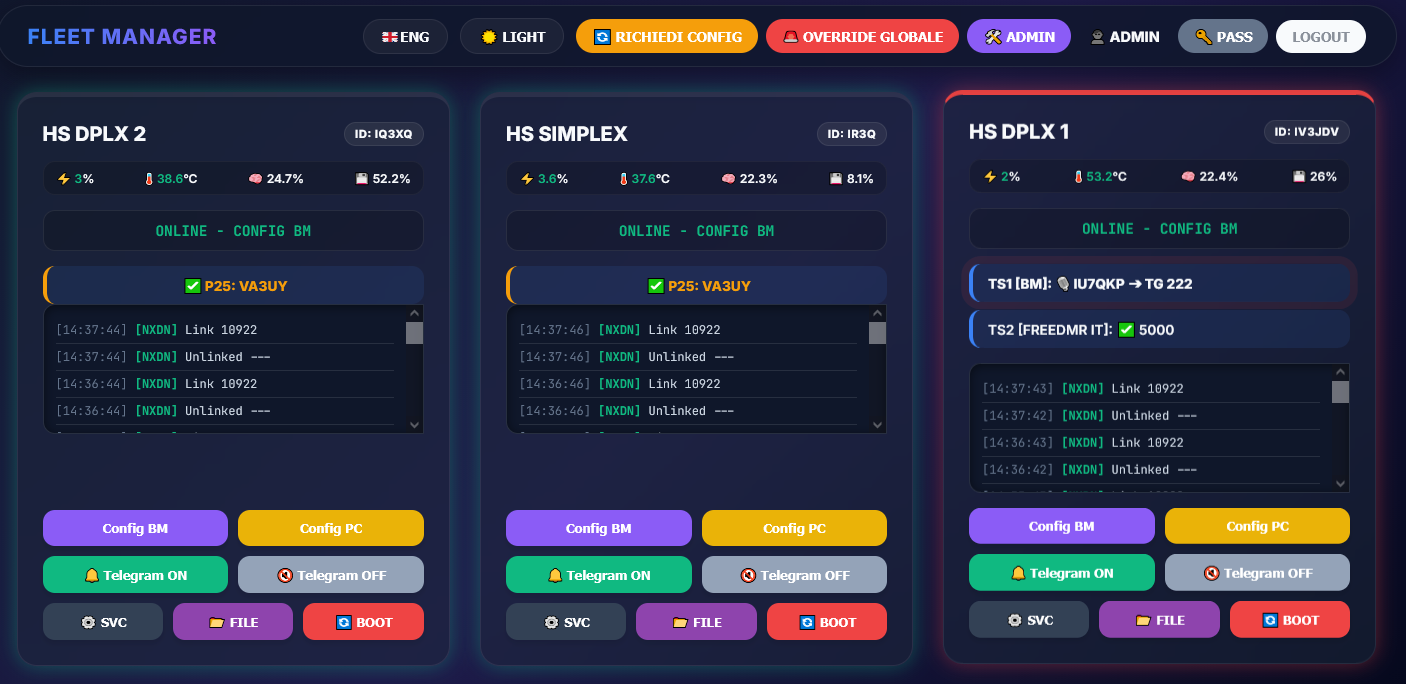
**Fleet Control Console** is a professional, real-time command and control (C2) dashboard designed for amateur radio repeater networks (MMDVM). It allows administrators to monitor and manage a "fleet" of remote digital voice nodes (DMR, NXDN, YSF, P25) through a single, elegant web interface.
### 🏗️ System Architecture
The ecosystem consists of three main parts:
1. **The Central Dashboard (`app.py`):** A Flask web server that handles the UI, user permissions (SQLite), and logic.
2. **The Remote Agent (`system_monitor.py`):** A lightweight script running on each repeater (Raspberry Pi/Linux) that monitors hardware and executes commands.
3. **The MQTT Broker:** The communication backbone. All data and commands flow through MQTT for near-instant responsiveness.
### ✨ Features
* **Centralized Telemetry:** Real-time CPU, RAM, Temperature, and Disk usage for all nodes.
* **Service Management:** Start, Stop, or Restart system daemons (MMDVMHost, DMRGateway, etc.) remotely.
* **Remote Configuration:** Built-in web editor for `.ini` files—no SSH required.
* **Live Transit Log:** Unified view of radio traffic across the entire network.
* **Profile Switching:** Toggle between different repeater setups (e.g., Profile A/B) with one click.
### 🚀 Installation & Setup
#### 1. Server Setup (Central Hub)
* Install dependencies: `pip install flask paho-mqtt psutil werkzeug`
* Configure `config.json` (use `config.example.json` as template) with your MQTT credentials.
* Define your repeaters in `clients.json`.
* Run: `python3 app.py`
#### 2. Agent Setup (Remote Nodes)
The `system_monitor.py` must be installed on every node you wish to monitor.
* Place `system_monitor.py` and `node_config.json` in a folder (e.g., `/opt/node_agent/`).
* Edit `monitor_config.ini` to set the `client_id` (must match the ID in `clients.json`) and MQTT credentials.
* (Recommended) Set up a systemd service to run the agent automatically at boot.
---
## 🇮🇹 Italiano
**Fleet Control Console** è una dashboard di comando e controllo (C2) professionale in tempo reale, progettata per le reti di ripetitori radioamatoriali (MMDVM). Permette ai gestori di monitorare e gestire un'intera "flotta" di nodi digitali (DMR, NXDN, YSF, P25) da un'unica interfaccia web raffinata.

### 🏗️ Architettura del Sistema
L'ecosistema si compone di tre parti principali:
1. **Dashboard Centrale (`app.py`):** Un server web Flask che gestisce l'interfaccia, i permessi utenti (SQLite) e la logica di controllo.
2. **Agente Remoto (`system_monitor.py`):** Uno script leggero in esecuzione su ogni ripetitore (Raspberry Pi/Linux) che raccoglie i dati hardware ed esegue i comandi.
3. **Broker MQTT:** Il centro nevralgico della comunicazione. Tutti i dati e i comandi viaggiano su MQTT per una reattività istantanea.
### ✨ Funzionalità
* **Telemetria Centralizzata:** Stato in tempo reale di CPU, RAM, Temperatura e Disco di tutti i nodi.
* **Gestione Servizi:** Avvio, arresto o riavvio dei demoni di sistema (MMDVMHost, DMRGateway, ecc.) da remoto.
* **Configurazione Remota:** Editor web integrato per i file `.ini`: modifica i parametri senza accedere in SSH.
* **Log Transiti Live:** Vista unificata del traffico radio di tutta la rete.
* **Cambio Profilo:** Commuta tra diversi assetti del ripetitore (es. Profilo A/B) con un clic.
### 🚀 Installazione e Configurazione
#### 1. Setup del Server (Hub Centrale)
* Installa le dipendenze: `pip install flask paho-mqtt psutil werkzeug`
* Configura `config.json` (usa `config.example.json` come base) con le credenziali MQTT.
* Definisci i tuoi ripetitori nel file `clients.json`.
* Avvia: `python3 app.py`
#### 2. Setup dell'Agente (Nodi Remoti)
Il file `system_monitor.py` va installato su ogni nodo che vuoi monitorare.
* Copia `system_monitor.py` e `node_config.json` in una cartella (es. `/opt/node_agent/`).
* Modifica `monitor_config.ini` impostando il `client_id` (deve corrispondere all'ID in `clients.json`) e le credenziali MQTT.
* (Consigliato) Crea un servizio systemd per avviare l'agente automaticamente al boot.
---
*Created by IV3JDV @ ARIFVG - 2026*